 ftpGrid menu
SFTP vs FTPS: which secure file transfer to use?
Published 2026-05-22 06:29:10.558346 by Carsten Blum
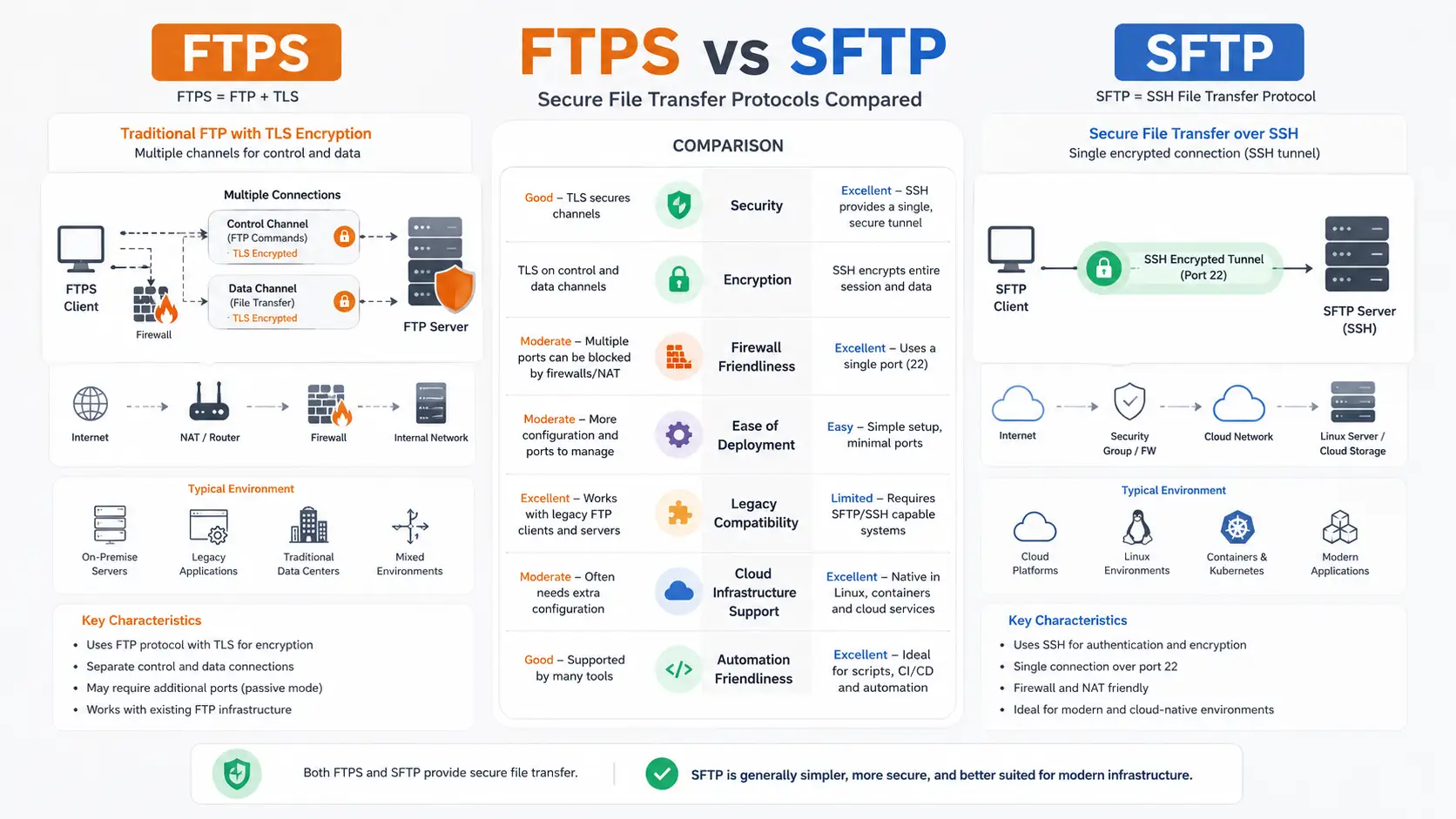
One of the most common misconceptions in file transfer infrastructure is that SFTP and FTPS are basically the same thing. They are often grouped together under the umbrella term “secure FTP”, which is understandable from a business perspective, but technically they are very different protocols with very different operational characteristics. Choosing the wrong one can create unnecessary complexity, especially once firewalls, automation and cloud infrastructure enter the picture.
The reality is that both protocols solve the same fundamental problem: securely transferring files between systems.
But they approach that problem in completely different ways.
What is SFTP?
SFTP stands for SSH File Transfer Protocol and is built directly on top of SSH. Unlike classic FTP, SFTP was designed with security in mind from the beginning and uses a single encrypted connection for both commands and data transfer. This makes it operationally much simpler in modern infrastructure environments.
Key characteristics of SFTP:
Built on SSH
Uses a single connection
Fully encrypted
Firewall friendly
Common in Linux and cloud infrastructure
Widely used in DevOps and automation
If you want to explore modern SFTP infrastructure further:
What is FTPS?
FTPS is fundamentally different. Instead of creating a completely new protocol, FTPS takes the original FTP protocol and adds TLS encryption on top. This is conceptually very similar to how HTTPS works compared to HTTP.
FTPS characteristics:
Classic FTP with TLS encryption
Supports existing FTP workflows
Often easier to adopt in legacy environments
Uses separate control and data channels
Can become operationally complex with firewalls and NAT
FTPS remains extremely common in enterprise environments where traditional FTP workflows already exist and migration costs are high.
SFTP vs FTPS: the biggest technical difference
The most important technical distinction is connection architecture. SFTP uses a single encrypted SSH tunnel for everything, while FTPS still relies on the older FTP model with separate channels for commands and data.
This has surprisingly large operational consequences.
SFTP uses:
One port
One encrypted tunnel
Simpler firewall configuration
Easier NAT traversal
Cleaner cloud deployment
FTPS uses:
Separate control and data connections
Passive or active mode handling
TLS negotiation
More complex firewall behavior
Additional networking considerations
This is one of the main reasons many modern cloud environments prefer SFTP operationally.
Security comparison
Both SFTP and FTPS are considered secure when configured correctly. The difference is less about encryption strength and more about operational simplicity and implementation complexity.
SFTP security advantages:
Security built directly into the protocol
SSH-based authentication support
Easier secure defaults
Smaller attack surface operationally
FTPS security advantages:
TLS-based encryption
Works well with existing FTP ecosystems
Mature enterprise tooling
Strong compatibility with older systems
In practice, both protocols can be extremely secure. The bigger risk is usually operational misconfiguration.
Which protocol is easier to use?
This depends heavily on the environment.
For modern infrastructure teams, SFTP is often easier because it behaves similarly to SSH infrastructure they already understand. For organizations deeply invested in traditional FTP workflows, FTPS may require less migration effort.
SFTP is often easier when:
Deploying in cloud infrastructure
Working with Linux systems
Managing firewalls
Building automation workflows
Using DevOps tooling
FTPS is often easier when:
Existing FTP workflows already exist
Legacy ERP integrations are involved
Older enterprise systems require FTP semantics
Minimal workflow redesign is preferred
SFTP in cloud infrastructure
One interesting trend over the last decade is how naturally SFTP fits into cloud-native infrastructure. Because the protocol is operationally simpler, it tends to integrate much more cleanly with containers, orchestration and modern networking models.
This is one of the reasons many companies are now adopting managed SFTP hosting instead of self-hosted FTP servers.
Typical cloud SFTP benefits include:
Simpler networking
Easier scaling
Centralized access management
Better automation support
Cleaner operational model
FTPS still has an important role
Despite the industry momentum around SFTP, FTPS is absolutely not obsolete. In fact, some of the world’s largest enterprise integrations still rely heavily on FTPS because replacing existing workflows can be extremely expensive and operationally risky.
FTPS remains common in:
Banking
Manufacturing
Legacy enterprise systems
B2B partner integrations
Industrial environments
In reality, many companies end up supporting both protocols simultaneously.
Which secure file transfer protocol should you choose?
There is no universal answer because the correct choice depends entirely on your infrastructure and operational requirements.
Choose SFTP if you want:
Simpler infrastructure
Easier firewall management
Better cloud compatibility
Modern automation workflows
SSH-based operations
Choose FTPS if you need:
Compatibility with existing FTP workflows
Minimal migration effort
Enterprise FTP ecosystem support
Legacy application compatibility
If you're evaluating modern managed SFTP infrastructure:
Final thoughts
SFTP and FTPS both solve the same business problem:
secure file transfer.
But technically they come from very different eras and design philosophies. FTPS extends the original FTP protocol into the modern world using TLS, while SFTP takes a completely different approach built around SSH.
The important thing is not necessarily choosing the “best” protocol universally.
The important thing is choosing the protocol that best matches:
Your infrastructure
Your operational model
Your automation requirements
Your security expectations
And increasingly, for modern cloud infrastructure, that choice ends up being SFTP.