 ftpGrid menu
Why managed SFTP reduces operational complexity
Published 2026-06-09 07:35:04.780088 by Carsten Blum
Most companies do not wake up one morning and decide they want to become experts in file transfer infrastructure. They simply need a reliable way to exchange files with customers, suppliers, partners and internal systems. Somewhere along the way, however, a seemingly simple SFTP server becomes a collection of security updates, user management tasks, storage planning, monitoring dashboards and operational procedures.
This is why managed SFTP hosting has become increasingly popular. Businesses are realizing that the real value lies in the workflows and integrations powered by file transfers, not in maintaining the infrastructure that makes those transfers possible.
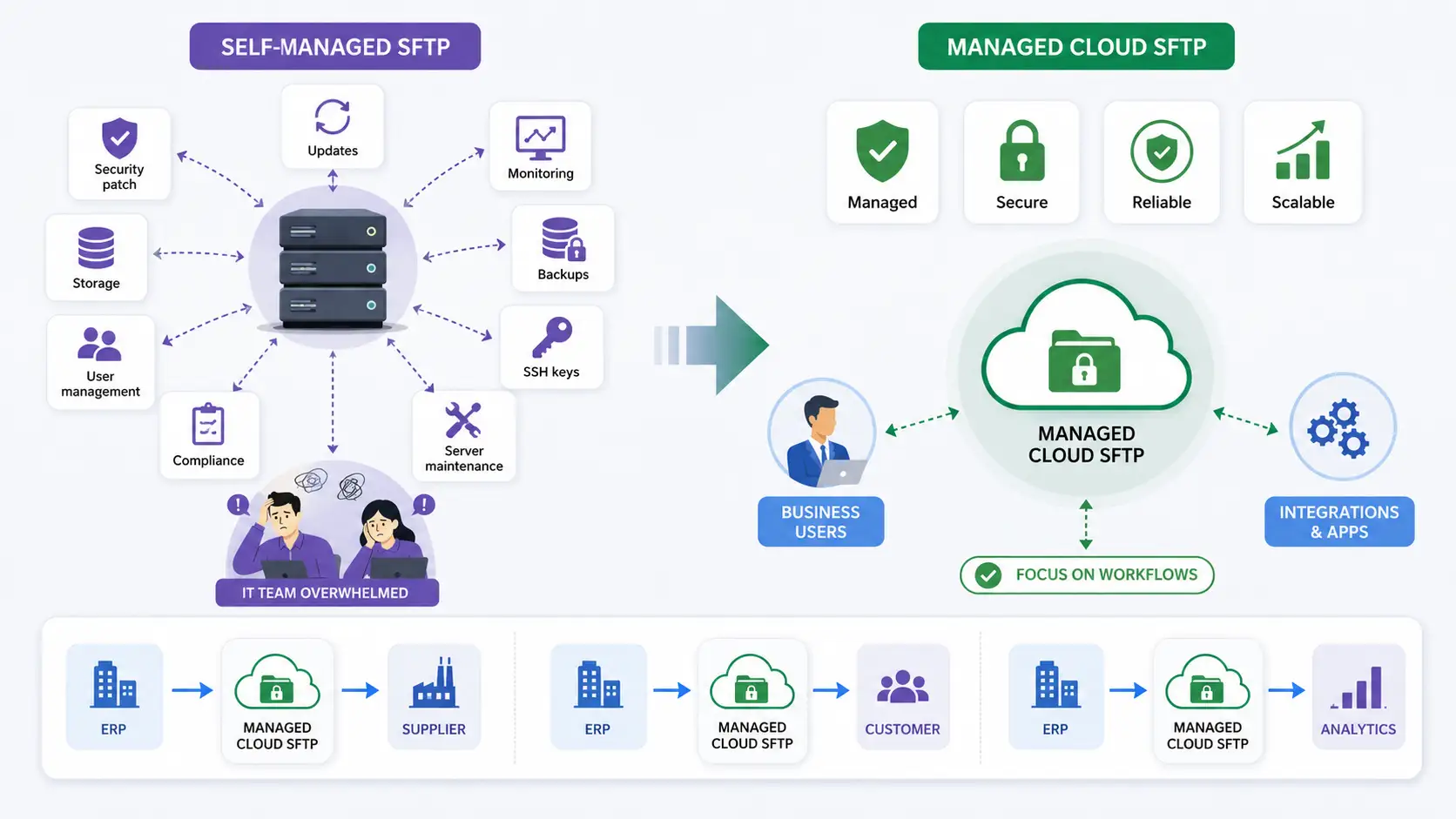
Complexity grows over time
Most SFTP environments begin with a single use case. Perhaps a supplier integration, a nightly ERP export or an automated backup workflow. Initially, the setup feels small and manageable.
Over time, however, additional requirements begin to appear:
New users
New partners
Additional storage
Security reviews
Compliance requirements
Monitoring and alerting
What started as a simple server often becomes an operational responsibility that nobody originally planned for.
Infrastructure is not the business goal
For most organizations, SFTP is not a product. It is not a competitive advantage. It is simply a tool that supports broader business processes and integrations.
The real priorities are usually:
Reliable file exchange
Business continuity
Secure data sharing
Customer service
Operational efficiency
Managed Cloud SFTP allows teams to focus on these goals instead of server administration.
Managed SFTP removes operational burden
A managed SFTP service shifts responsibility for infrastructure operations to a specialized provider. Instead of maintaining servers and security controls internally, businesses consume SFTP as a service.
This reduces the need to manage:
Operating systems
Security patching
Infrastructure monitoring
Storage provisioning
Backup infrastructure
Availability management
The result is often a simpler and more predictable operational model.
Stability creates trust
One of the most overlooked benefits of managed infrastructure is stability. Business workflows often depend on file transfers happening reliably every day, every week and every month without intervention.
Organizations typically care less about the server itself and more about confidence that the workflow will continue operating.
Managed platforms often provide:
High availability
Infrastructure monitoring
Proactive maintenance
Capacity management
Operational expertise
This allows businesses to focus on outcomes rather than infrastructure.
Security becomes easier to manage
Security is rarely a one-time activity. It is an ongoing process that requires continuous attention and expertise.
A managed SFTP provider typically handles many security-related responsibilities on behalf of customers.
Examples include:
Security updates
Infrastructure hardening
Vulnerability management
Access controls
Secure authentication
Encryption standards
For many organizations, this reduces both risk and administrative overhead.
Scaling becomes predictable
Business requirements rarely remain static. Storage requirements grow, integrations increase and new partners join the ecosystem.
The challenge with self-managed infrastructure is that scaling often becomes a project of its own.
Managed Cloud SFTP hosting typically simplifies:
Storage expansion
User growth
Partner onboarding
Geographic access
Performance management
This allows businesses to scale without redesigning infrastructure.
Automation works better when infrastructure disappears
Modern businesses increasingly rely on automated workflows. ERP exports, EDI exchanges, reporting systems and backup processes often operate without human intervention.
The less operational friction around the underlying infrastructure, the easier these workflows become to maintain.
Typical automation scenarios include:
ERP exports
Supplier integrations
Customer data feeds
Backup replication
Reporting workflows
EDI exchanges
For more examples:
Compliance and governance matter
Infrastructure decisions increasingly involve legal, compliance and governance considerations. Organizations need confidence regarding where data resides, who operates the platform and how information is protected.
Managed services can simplify many compliance-related activities.
Important considerations include:
GDPR compliance
Data residency
Auditability
Data processing agreements
Access management
Operational transparency
This is particularly relevant for businesses operating within Europe.
Managed SFTP versus hyperscaler cloud
Large hyperscaler platforms provide enormous flexibility and virtually unlimited building blocks. For many organizations, however, flexibility comes at the cost of complexity.
Businesses often discover that they do not actually need dozens of services and configuration options. They simply need secure and reliable file transfer infrastructure.
A managed SFTP platform provides:
Faster deployment
Simpler administration
Predictable operations
Reduced learning curve
Purpose-built functionality
For many use cases, simplicity creates more value than flexibility.
Business use case: supplier data exchange
Imagine a manufacturing company exchanging inventory data, forecasts and purchase orders with suppliers. The company needs secure file transfer, reliable automation and operational visibility.
The business benefits from the workflow itself rather than the infrastructure supporting it.
Typical priorities include:
Reliability
Security
Compliance
Automation
Ease of use
Managed Cloud SFTP services help organizations achieve these goals without building and maintaining infrastructure internally.
For more examples:
Choosing the right operational model
The question is not whether self-managed SFTP works. It certainly does, and many organizations operate successful environments.
The more important question is whether managing SFTP infrastructure contributes directly to business value.
Self-managed SFTP may be appropriate when:
Extensive customization is required
Internal expertise is available
Infrastructure ownership is a strategic goal
Managed SFTP may be appropriate when:
Operational simplicity is preferred
Faster deployment is important
Predictable costs are desirable
Infrastructure management is not a business priority
Final thoughts
Managed SFTP is not fundamentally about file transfers. It is about reducing operational complexity so organizations can focus on the workflows, customers and integrations that actually create value.
As businesses continue to automate data exchange and expand partner ecosystems, the operational burden of managing infrastructure often outweighs the perceived benefits of owning it.
For many organizations, consuming SFTP as a service simply becomes the most practical and efficient option.
If you're evaluating modern SFTP infrastructure, start here: